
Do I Need SEO or Google Ads?
If you are unsure whether to invest in SEO or Google Ads, base the decision on how quickly you need leads, how customers search, your available budget, and the long-term value of organic visibility.
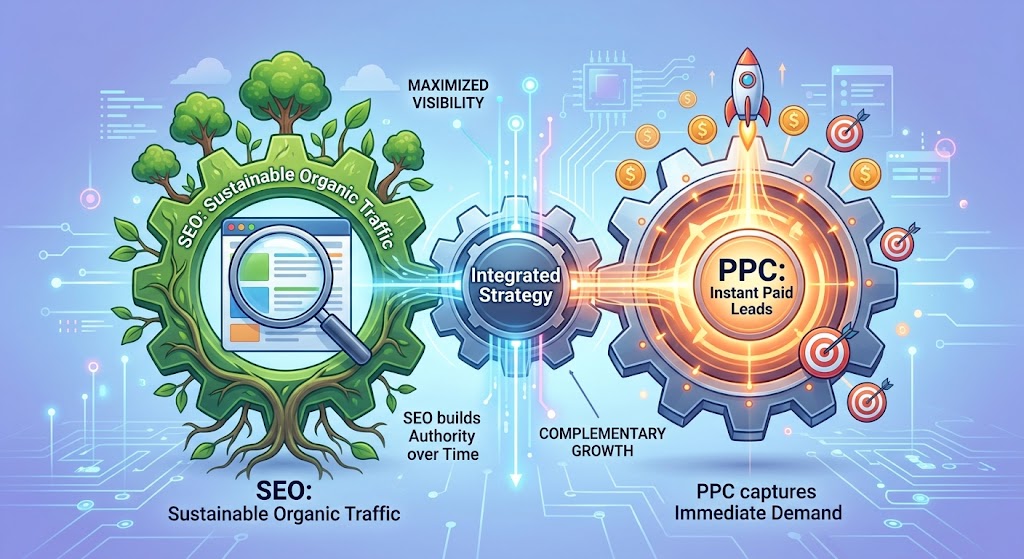
SEO builds organic search visibility over time. Google Ads buys immediate visibility for selected searches. Many businesses benefit from both, but the right investment depends on the commercial problem you need to solve.
Should I Choose SEO or Google Ads?
Choose SEO when you want sustainable organic traffic and can invest over a longer period. Choose Google Ads when you need immediate search visibility and can pay for each click.
The core differences are:
| Factor | SEO | Google Ads / PPC |
|---|---|---|
| Search visibility | Organic results | Paid placements |
| Traffic cost | No direct cost per organic click | Advertiser pays per click |
| Speed | Usually requires time to build | Can generate visibility after campaigns become eligible to serve |
| Longevity | Rankings can continue generating traffic | Traffic generally stops when advertising stops |
| Targeting control | Lower direct control | High control over keywords, locations, audiences and schedules |
| Testing | Slower feedback cycle | Faster keyword and conversion testing |
| Main strength | Compounding search visibility | Immediate, controllable search exposure |
The choice becomes clearer when you connect these differences to your current sales objective.
When Does SEO Make More Sense?
SEO makes more sense when potential customers repeatedly search for your products or services and you want to build a durable source of organic traffic.
SEO can support your business when you:
- Want to reduce dependence on paid acquisition over time.
- Serve customers who research before buying.
- Target multiple relevant commercial searches.
- Publish useful content around customer problems.
- Compete in a market where organic search influences purchasing decisions.
- Can wait for search engines to crawl, evaluate and rank improved pages.
SEO does not produce guaranteed rankings. Competitors, website quality, technical accessibility, content relevance, links and search-engine changes can affect organic performance.
That makes SEO an investment in search visibility rather than a purchase of a specific ranking position.
When Should I Use Google Ads Instead of SEO?
Use Google Ads when speed, targeting and immediate commercial visibility matter more than building organic rankings first.
Google Ads can fit businesses that need to:
- Generate leads for a new service.
- Promote an offer immediately.
- Target high-intent commercial keywords.
- Reach customers within specific locations.
- Test whether search demand converts into enquiries or sales.
- Measure campaign performance against defined conversion actions.
For example, a business launching a new service does not need to wait for a new page to gain organic visibility before testing demand. A paid search campaign can target relevant queries while the business develops its SEO presence.
The trade-off is cost. Google Ads operates through an advertising auction, and advertisers can pay when users click their ads.
Is SEO Cheaper Than Google Ads?
SEO and Google Ads use different cost models, so comparing them purely by price can mislead you.
With PPC, you fund advertising spend and typically pay for clicks. With SEO, organic clicks do not carry a direct media charge, but achieving visibility requires investment in strategy, content, technical improvements, digital PR, analysis or related work.
The better question is:
Which channel produces profitable customers at an acceptable acquisition cost?
That question shifts the decision from marketing cost to commercial return.
How Quickly Does SEO Work Compared With PPC?
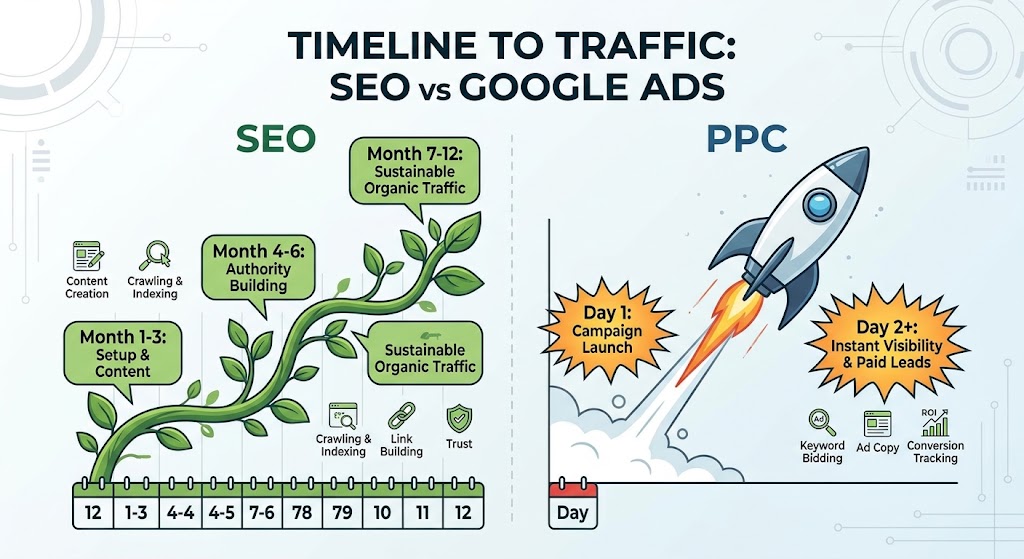
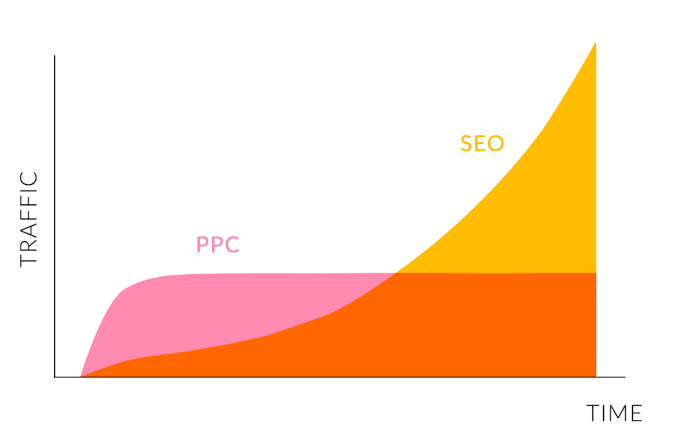
Google Ads can provide search visibility much faster than SEO because an eligible campaign can enter advertising auctions without waiting for organic rankings to develop.
SEO normally takes longer because search engines must discover, process and evaluate pages against competing results.
No responsible SEO provider can guarantee an exact date when a page will achieve a particular organic ranking.
Your existing authority, competition, website condition, content quality and target queries all influence the timeframe.
If lead generation cannot wait, PPC can address the immediate demand while SEO develops a longer-term acquisition asset.
Should a New Business Start With SEO or PPC?
A new business can use PPC to test commercial demand while building SEO foundations.
Paid search data can reveal which queries attract clicks and which landing pages generate conversions. SEO can then target validated customer needs through service pages, category pages, supporting content and technical optimisation.
A practical sequence can look like this:
- Identify high-intent customer searches.
- Launch tightly controlled PPC campaigns.
- Measure leads, sales and conversion rates.
- Improve landing pages using real customer behaviour.
- Build organic pages around valuable search topics.
- Compare acquisition costs across paid and organic search.
- Allocate future budget according to commercial performance.
This approach does not make PPC a substitute for SEO. It uses each channel for a different function.
Can I Use SEO and Google Ads Together?
Yes. SEO and Google Ads can operate together because they solve different search marketing problems.
PPC captures immediate demand. SEO develops organic visibility.
A combined strategy can work when you want to:
- Capture valuable searches while organic rankings develop.
- Test keywords before committing significant SEO resources.
- Increase search presence across paid and organic results.
- Support seasonal or time-sensitive campaigns with PPC.
- Build evergreen search visibility through SEO.
- Compare conversion performance across acquisition channels.
The correct budget split depends on margins, conversion rates, search demand, competition and business objectives.
What If My Google Ads Are Too Expensive?
Expensive clicks do not automatically mean you should stop PPC. You first need to determine whether those clicks produce profitable customers.
Measure metrics such as:
- Cost per click (CPC) shows what you pay for traffic.
- Conversion rate shows how frequently traffic produces a desired action.
- Cost per acquisition (CPA) shows what acquiring a conversion costs.
- Customer value shows what acquired customers contribute commercially.
- Return on ad spend (ROAS) compares attributed revenue with advertising spend where revenue tracking applies.
A £10 click can be commercially attractive for one business and unprofitable for another. Customer value and conversion performance determine the difference.
If PPC cannot acquire customers economically, SEO may provide another route to relevant search demand. Poor PPC economics can also indicate problems with targeting, offers or landing pages rather than the channel itself.
What If SEO Is Taking Too Long?
SEO taking longer than expected requires diagnosis before additional investment.
Check whether your website:
- Targets queries that match customer intent.
- Provides pages that directly satisfy those searches.
- Allows search engines to crawl and index important URLs.
- Demonstrates relevant expertise and topical depth.
- Earns credible references and links where appropriate.
- Converts organic visitors into enquiries or customers.
Google Ads can provide short-term search exposure while these issues receive attention.
The two channels can therefore address different stages of the same acquisition problem.
SEO vs PPC: Which Is Better for Lead Generation?
Neither channel is universally better for lead generation. The stronger channel is the one that produces qualified leads at a commercially viable cost and supports your required timeframe.
Use this decision framework:
| Your situation | Consider |
| You need leads immediately | Google Ads |
| You want long-term organic visibility | SEO |
| You want to test search demand quickly | Google Ads |
| Customers perform extensive online research | SEO |
| You have a time-sensitive promotion | Google Ads |
| You want to build an evergreen search asset | SEO |
| You need leads now and future organic growth | SEO + Google Ads |
| You do not know which keywords convert | Test with PPC, then use the evidence across search strategy |
This framework gives you a starting point. Your economics determine the final allocation.
How Do I Know Where to Put My Marketing Budget?
Start with the commercial outcome rather than the marketing channel.
Ask four questions:
- How soon do you need new enquiries or sales?
- What can you afford to pay to acquire a customer?
- Which searches indicate genuine buying intent?
- Do you need immediate demand capture, long-term visibility, or both?
If you need customers quickly, PPC often deserves greater initial investment.
If you can invest for longer-term search visibility, SEO can deserve a greater share.
If both objectives matter, separating the budget between SEO and paid search can prevent you from forcing one channel to perform two different jobs.
Do I Need SEO, PPC or Both?
Choose SEO for sustainable organic search growth. Choose PPC for immediate, measurable search exposure. Choose both when you need leads now while building a longer-term organic acquisition channel.
Digital Marketing First can assess your search demand, website, competition and commercial objectives before recommending where the budget should go.
The recommendation should not begin with “SEO or PPC?”
It should begin with “What needs to happen commercially, and which search channel can achieve it efficiently?”
That gives you a defensible reason to invest in SEO, Google Ads, or a coordinated search strategy rather than choosing a channel based on assumptions.